Light that knows what time it is.
Skenara builds smart homes, and manufactures the two parts of one you actually see and touch: the light in the ceiling and the key on the wall. Climate, blinds, gates and the rest we integrate and hide in the board, which is where they belong.
 Free, about forty minutes, and it ends with a straight answer — including “you do not need us”.
 Circuit, firmware and casing all ours
 Ra and R9 measured per batch
 KNX locally, Matter on the keypad
 Lighting design, not fitting layout
 5 years warranty · 10 years spares
A house that already knows the hour.
Tonight, at half past six in November, you will come home, press the one switch by the door, and stand in a room lit like an office. Then you will spend four hours in it.
Before the alarm
The hall floor comes up to three per cent. Enough to cross the room. Not enough to wake anybody still asleep.
The kitchen, on a work day
Cold and nearly full — four thousand kelvin against a Kraków January that gives you nothing until nine.
Sunset, whenever it happens
In December it is now. In June it is at nine. Either way the house has been warming the light for half an hour, and nobody set a timer.
One press before the film
The room falls to the screen. The kitchen holds ten per cent so somebody can find a glass. The hall goes out.
The last one up
Landing, then stairs, then the ground floor behind them. By the time the bedroom door shuts there is nothing left on in the house.
Four of those five happen without anybody deciding anything. The fifth is one press. Not one of them is an app.
See what an evening like this costs
They removed half the fittings, and it got brighter.
A light meter on the floor reads lower. The room reads brighter. Both are true at once, and the reason is simply where the light is pointed: walls take up most of what your eye actually sees and give back 50 to 70 per cent of the light that hits them. A floor gives back 10 to 30 and is mostly covered in furniture.
So the usual grid of downlights spends its budget lighting a floor nobody looks at. Aim the same light at the walls and you need fewer fittings, the ceiling gets quieter, and the room gets brighter. This is the whole of our argument, and it is the one you can check with your own eyes.
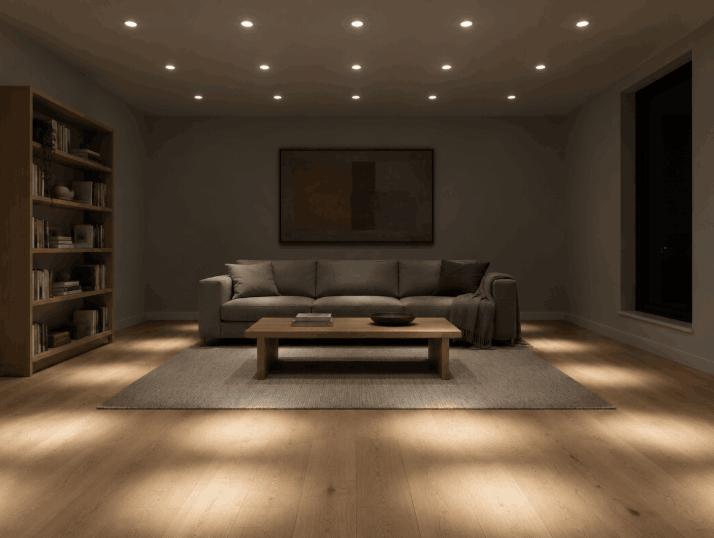
Even grid, everything aimed down. 300 lux on the floor, grey walls, and a ceiling that looks like a server room.
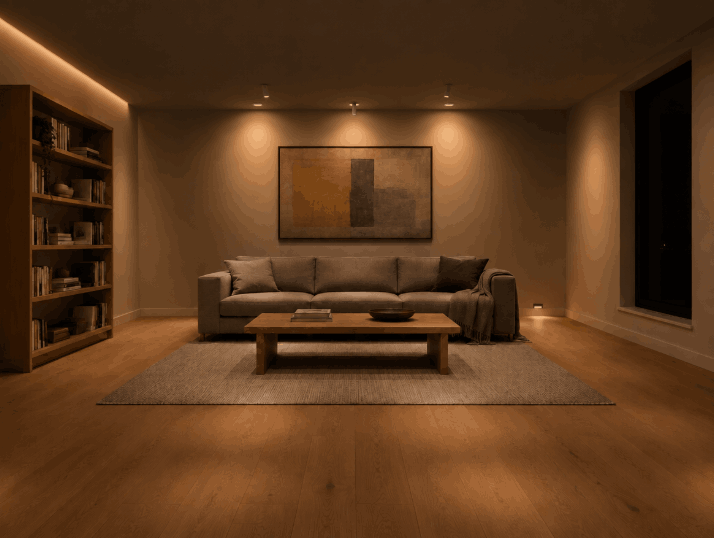
Wall washing, two accents, a floor path. Less on the meter, more in the room — and half the holes in the ceiling.
We will do this on your own ceiling plan for free, before you have committed to anything. That is the offer at the bottom of this page.
We make two things, integrate the rest, and say which is which.
A single line, in writing, before you buy anything. It is the shortest way to explain both why we cost what we cost and why we do not quote for the things below.

We make this
The fittings, the keys, the scenes and the lighting design. Our circuit, our firmware, our casing — so the warranty, the certification and the batch are ours to answer for.
Five years, ten years of spares
We integrate this
KNX gateways, drivers, relays, climate, shading, locks, sensors, and whichever platform is already on your phone. Specified and commissioned by us, supplied under the maker's own warranty.
Compatibility is ours, the badge is theirs
We do not touch this
Structured cabling, CCTV, data networks, AV and distributed audio, alarms, first fix and making good. Named here so nobody discovers it on site.
Handover or your own contractorThe key on the wall is the whole product, in one part you can pick up.
It is the only piece of a smart home that you touch — twenty times a day, for fifteen years. Everything else is in a cupboard. So we build it as an object, in two lines, and we send samples before anyone asks.
Keys Core
€90–140Volume work and base packages. The key travels with the light and the design, not as a line item on its own.
Against Jung F40 and base Gira.Keys Pro
€280–350Private homes and designer projects, where the key ends up in the moodboard next to the tapware.
In the gap between Berker at €250 and Basalte at €495, where there is currently almost nobody.Put an ordinary three-euro switch next to either one and press both. Nothing we could write here does that comparison as well as your own thumb, which is why the sample kit exists and why it is free.
Two questions to put to every supplier you talk to.
Including us. If an answer is vague, that tells you more than any brochure — and you will remember who taught you to ask.
“Does your driver hum at twenty per cent?”
Drivers are loudest exactly where the evening lives. In a quiet bedroom at low output you hear it, and once you have heard it you cannot unhear it. We measure it, we put it in the batch paperwork, and a humming batch goes back.
 Measured and paperworked per batch.
“Is every fitting its own address, or does the whole line go on together?”
Plenty of cheap DALI gateways run in broadcast and hide it behind “supports up to N devices” — which is the bus power supply's capacity, not the number of things you can control separately. Ask, then ask them to prove it on one fitting.
Per-address DALI, provable on site.Ra, R9, SDCM, Matter, dim-to-warm — all real, all on the reference pages, none of it needed in a first conversation. Ask us the two questions above and you will learn more in a minute than a datasheet gives you in an hour.
Four things that cost almost nothing to build in, and that nobody builds in.

Dim-to-warm to 2200 K
Dim the room and the light must warm as it goes down. Without it, low light stays at 2700 K and turns grey — which is why most people quietly believe dimmed light is depressing. The most under-rated parameter on the market.

Down to 0.1 per cent
The difference between ten per cent and one is the difference between dimmed and intimate. The whole evening and the whole night live below the point where domestic drivers give up.

A logarithmic curve
The eye is not linear. On a linear dimmer half the travel does nothing at all and the last ten per cent falls off a cliff into darkness.

Silent at twenty per cent
Measured, written into the batch record, and a humming batch is returned to the factory rather than to your ceiling.
Every value we publish is measured on your batch, and the batch number goes into the property file. Everyone else copies the manufacturer's datasheet. In three years, a replacement fitting is picked from the same batch by number rather than chosen because it looks similar — which is a thing only the manufacturer can do.
The whole home, including the parts nobody photographs.
We automate all of it. What makes us different is not the list — every integrator has this list — it is that we can calculate the light.
KNX runs the building locally. If our servers went dark tomorrow, every key in the house would still switch, every scene would still run, and nothing would need an app.
You come in with both hands full
The hall and kitchen come up to the level they were at last night, not to full. Nothing is pressed.
The guest wing drops two degrees
Nobody has slept in it since August. It holds at fifteen instead of twenty-one, and comes back up the day before anyone arrives.
The west facade closes on its own
Only the rooms the sun has actually reached. The north side stays open, because shutting it would just make the room dark.
The bill went up by a fifth
Circuit-level history says which one: the pool pump ran all month because somebody bypassed the timer in June.
The cleaner arrives on a Thursday
Her code opens the gate and the side door on Thursdays between ten and two, and on no other day at no other hour.
A hose fitting lets go under the sink
The sensor sees water, the valve shuts, and the phone rings. The alternative is finding out at seven.
The film starts
One press takes the lights, the blinds and the amplifier together. Three systems, one key, no remote on the table.
Somebody asks the house out loud
It works, and it is the slowest way to do it. The wall is faster and always will be — which is why the wall is the product.
One worked example, rather than a price list.
A 120 m² apartment, everything included — fittings, keys, the board, installation, commissioning and scenes. Your home is not this home, which is why the number comes after we look at the plan and not before.
| Fittings, 40 of them | 40 × €95 | €3,800 |
| Keys Pro, 10 of them | 10 × €300 | €3,000 |
| Board and control gear | integrated, not ours | €1,800 |
| Installation, commissioning, scenes | including Skenara Night | €2,500 |
 Polish price lists for a “smart home” almost always mean the control system without any fittings at all — so a lower number elsewhere is usually a smaller scope, and you will buy the lights separately without knowing what you are buying. Ask what is in the number before you compare it to this one.
The design fee is paid once and credited in full against the equipment. Take the drawings and build with any contractor you like — they are yours, fully paid for, and we will not ask for them back.
Eight points, one PDF, no email gate.
Our fitting costs several times what a builders' merchant charges. That is only defensible if the standard behind it is written down and checkable — so it is published in full, with the measurement method, and you can take it to any supplier including us.
Most of our work arrives through a designer. Some arrives directly.
You are furnishing your own home
Send the ceiling plan. Forty minutes, free, and you leave with a scope, a number that holds for six months, and a date. The design fee credits in full against the equipment.
How it works for private clientsYou are an interior designer
We calculate the light under your interior, hand you drawings your electrician cannot misread, and never put our name in front of yours. Samples go out before you ask.
How we work with designersWe do work per-unit, and the argument there is different: lighting and control land at about two per cent of a unit's price and come back at three to five. But we are three people and we take developments on deliberately slowly — one at a time, starting with a show apartment we equip at our own cost.
What works where, checked and dated.
Platforms move at different speeds and not everything is supported everywhere. We publish the honest version with the date we last tested it.
| Apple Home | Google Home | Alexa | SmartThings | |
|---|---|---|---|---|
| Lighting, dimmable | Full | Partial | Full | Full |
| Keys and relays | Full | Not yet | Full | Full |
| Climate, thermostat | Full | Full | Full | Full |
| Curtains and blinds | Full | Partial | Partial | Full |
| Energy metering | Not yet | Not yet | Partial | Full |
Last verified 4 August 2026. One thing worth knowing about how this is built: only the keypad carries Matter certification. The fittings sit on DALI behind a per-address gateway, and the gateway is what appears on the platform — which is why adding a fitting never means re-certifying anything.
Skene: the façade the audience looked at.
σκηνήskēnē · the façadeIn the Greek theatre the skēnē was the building behind the acting floor — the one surface the audience ever saw. The word grew from a canopy that gave shade, and it is kin to skia, "shadow". Behind that façade were the dressing rooms, the props and the machinery. The audience never saw any of it. They saw what they were shown.
A smart home is built exactly the same way. Behind the wall sit the panel, the gateways, the drivers, the bus, the server. The person who lives there will not see one of them in ten years. They see light, and they touch a key. That is their entire skene.
So that is what we work on. We make the light, we make the keys, and we design how they work together — as scenes, as layers, as states of a room at different hours.
The machinery behind the wall has to be reliable. But it is not what anyone judges a home by.
Skenara. The visible layer of the smart home.
Send us the ceiling plan.
Forty minutes, free, no obligation. You will get the fitting count we would use, where the light falls short, and a straight answer about whether you need us at all.
- 01You send the planA PDF, a photo of the drawing, or nothing at all — we can start from a room count.
- 02We read it and call onceForty minutes. You get the count of fittings, the count of keys and where the board goes.
- 03You keep the drawingYours whether you buy from us or not. That is what makes it worth your hour.
